TL;DR
Service pages should target buyer-intent keywords and convert visitors, while blog posts should answer informational questions and support those pages with topical depth. The strongest SEO plan uses both: service pages as evergreen commercial assets, blog posts as supporting content, and clear internal links to avoid cannibalization.
Ranking at position 8.8 can mean the topic is right but the page needs sharper intent alignment. For service pages vs blog posts seo, the winning answer is simple: service pages sell a specific offer, blog posts educate around related questions, and both need distinct keyword targets. SEO: the practice of improving website and web page visibility and performance in search engine results. Blog post: an informational entry, often published in reverse chronological order, that answers a timely or educational topic. Service page: an evergreen commercial page that explains an offer, location, process, proof, and next step. Teams using Earlyseo can map those assets into a cleaner search strategy without turning every keyword into another blog post.
Table of Contents
What is the difference between service pages and blog posts for SEO?
Service pages and blog posts differ because service pages match transactional intent, while blog posts match informational intent. A service page should rank for searches where someone wants a provider, quote, booking, or productized solution. A blog post should rank for searches where someone wants an explanation, checklist, comparison, or answer before choosing.
Competitors often describe the difference as "pages are evergreen, blogs are fresh." That's true, but incomplete. The stronger SEO distinction is job-to-be-done: service pages convert demand, blog posts create and capture demand.
Key insight: A blog post can attract traffic, but a service page is usually the better landing page for leads, appointments, demos, and local service searches.
Comparison table for search intent and page role
| Factor | Service page | Blog post |
|---|---|---|
| Primary intent | Commercial or transactional | Informational or exploratory |
| Best keywords | "accounting services for startups," "emergency plumber Austin" | "how to choose an accountant," "why pipes burst in winter" |
| Main goal | Generate inquiries, bookings, calls, purchases | Build authority, answer questions, support internal links |
| Content lifespan | Evergreen, updated when offer changes | Updated when guidance, examples, or SERPs change |
| Conversion elements | Pricing cues, proof, FAQs, CTA, contact options | Examples, steps, definitions, related links |
| SEO risk | Thin copy, weak proof, duplicated city pages | Cannibalizing service keywords, weak internal links |
BrightEdge's 2019 research reported that 68% of online experiences begin with a search engine. Ahrefs also reported that 96.55% of content gets no Google search traffic. Those numbers make the page type decision matter: the wrong format can bury otherwise useful content.
When should a service page rank instead of a blog post?
A service page should rank when the searcher is close to taking action, comparing providers, or looking for a solution in a specific category or location. Queries with words such as "services," "agency," "near me," "pricing," "consultant," "company," or a city name usually deserve a service page, not a tutorial.
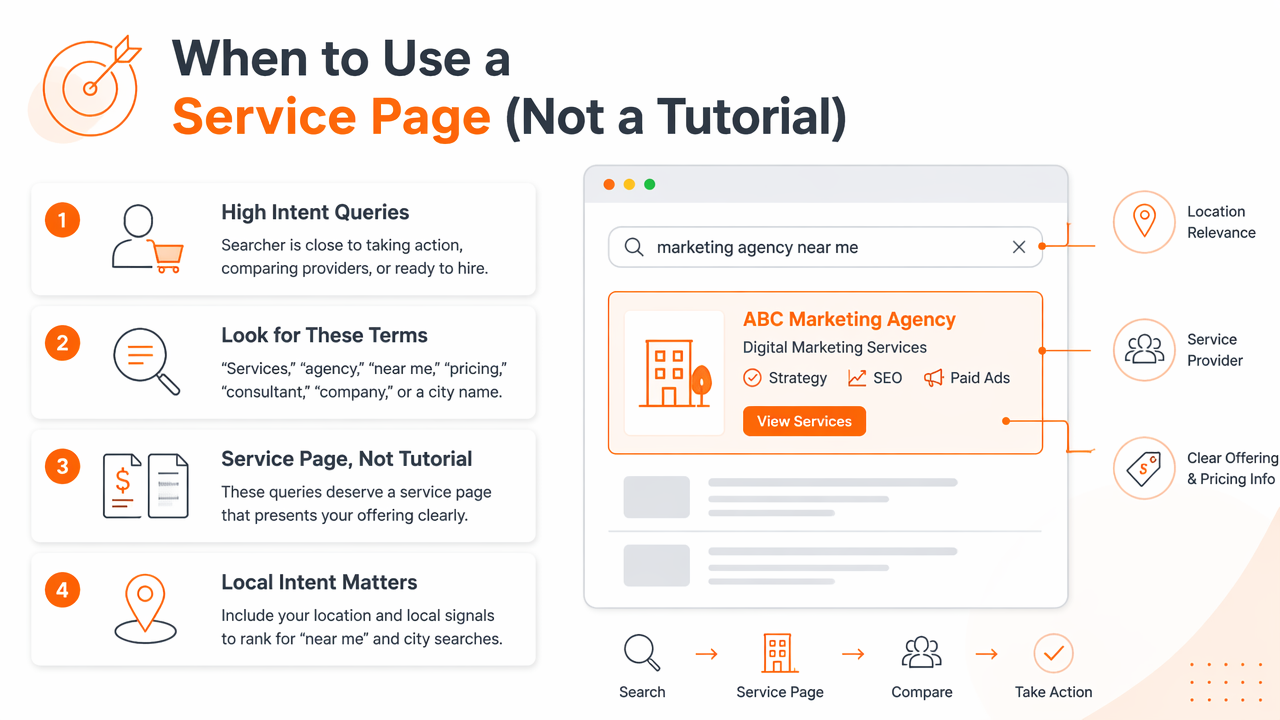
A local business example makes this clear. "Roof repair Dallas" should lead to a roof repair service page with coverage areas, emergency availability, proof, reviews, and a call option. "How long does roof repair take?" should be a blog post that educates and links toward the repair page.
Use a service page when the keyword implies:
- A provider search, such as "SEO consultant for SaaS"
- A location search, such as "family lawyer Phoenix"
- A comparison with buying intent, such as "Shopify SEO agency vs freelancer"
- A direct service need, such as "technical SEO audit service"
- A pricing or package evaluation, such as "local SEO packages for small business"
Service pages should not read like brochures. Strong ones include a clear offer, audience fit, process, examples, objections, proof, and a next step. For teams building service clusters, Earlyseo's content workflow for blogs can support the educational layer that points back to those money pages.
Key insight: If the searcher likely wants to hire, buy, call, compare providers, or request a quote, the service page should be the primary ranking target.
When should a blog post support a service page?
A blog post should support a service page when the keyword answers a question that comes before the buying decision. Blog posts build topical authority by covering definitions, comparisons, mistakes, checklists, examples, and decision criteria that a service page cannot cover without becoming bloated.
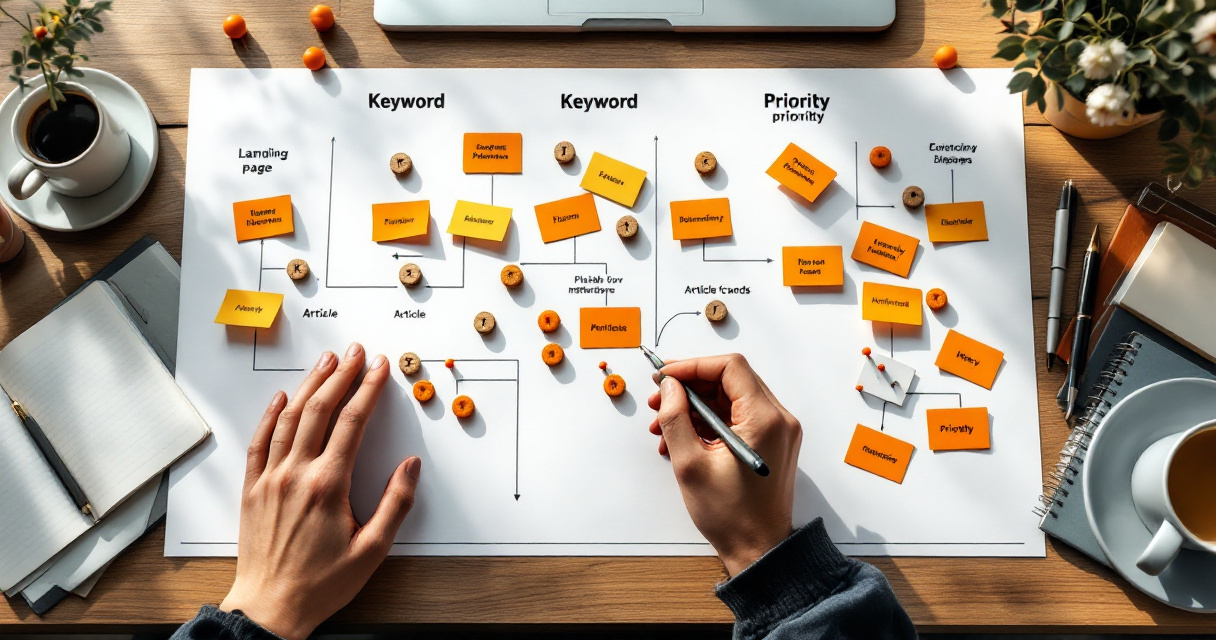
A good support post earns rankings without stealing the service page's main keyword. For example, an e-commerce SEO service page might target "Shopify SEO services," while supporting posts target "Shopify collection page SEO," "how to fix duplicate product descriptions," and "Shopify title tag examples." Stores using Shopify can pair that content with the Earlyseo Shopify integration to keep publishing and optimization work closer to the platform where changes happen.
Blog posts also matter for AI search. Research on retrieval-augmented generation for large language models reviews how systems can retrieve external information before generating answers. Research on generative AI describes how modern systems create text, code, images, and other outputs from learned patterns. In practical SEO terms, clear definitions, tables, FAQs, and entity-rich explanations make content easier for search and answer systems to parse.
Helpful blog post formats include:
- Definition posts: explain core terms that buyers search early.
- Comparison posts: compare options without forcing a sales pitch.
- Checklist posts: help readers evaluate readiness or quality.
- Problem posts: explain symptoms, causes, and fixes.
- Example posts: show what good execution looks like.
A blog post should link to the relevant service page using descriptive anchor text. It should also link sideways to related guides when that improves context. The content must answer the informational query first, then guide the reader toward the commercial next step.
How to avoid cannibalization between service pages and blog posts?
Avoid cannibalization by assigning one primary intent, one primary keyword group, and one primary conversion path to each URL. When a blog post and service page both chase the same commercial keyword, search engines may struggle to choose the right page, and users may land on content that does not match their goal.
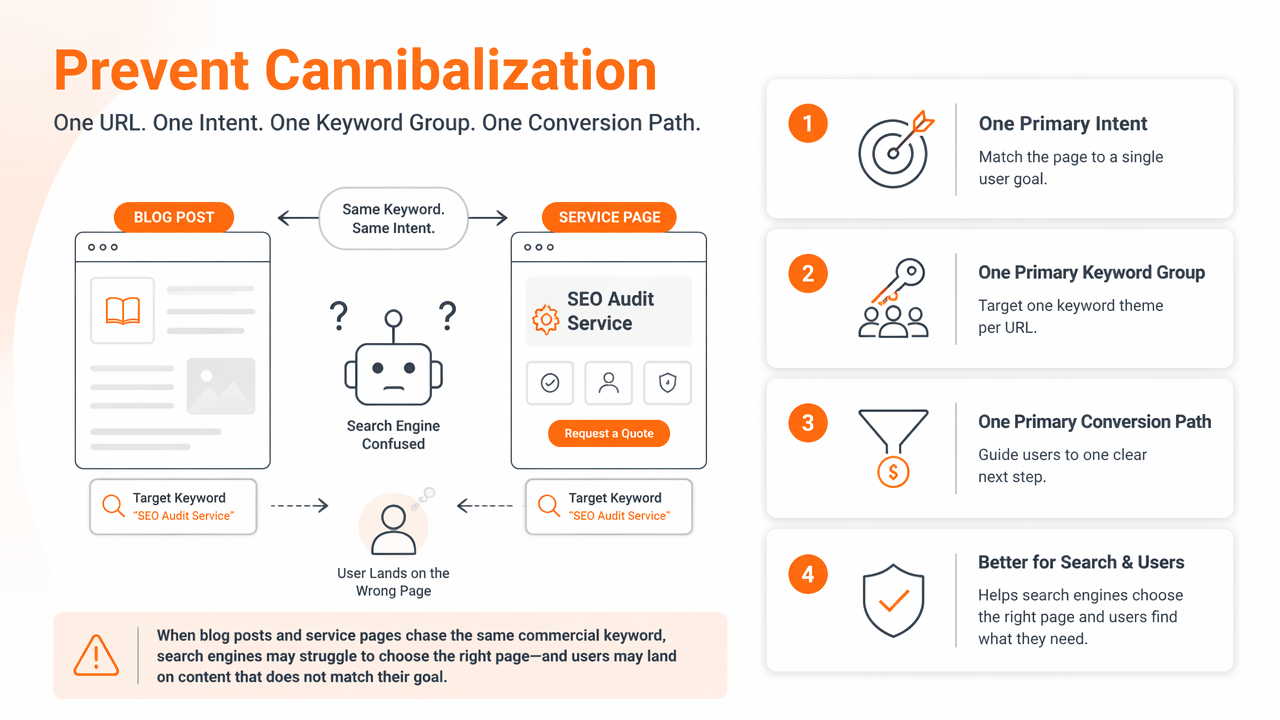
Cannibalization is not caused by mentioning the same topic twice. It happens when multiple URLs compete for the same query with similar intent. A blog post titled "Best local SEO services for dentists" may compete with a dental SEO service page. A post titled "How dentists can improve local rankings" is less likely to compete because the intent is educational.
Key insight: Topic overlap is healthy; intent overlap is the problem.
Cannibalization prevention checklist
- Pick the commercial page first. Assign the buyer-intent keyword to the service page.
- Build a support map. Give each blog post a question, comparison, or educational angle.
- Use distinct titles. Keep service titles offer-led and blog titles answer-led.
- Match CTAs to intent. Service pages can push booking; blog posts can suggest the next resource.
- Link upward. Blog posts should point to the most relevant service page.
- Review SERPs. If Google ranks mostly service pages, avoid publishing a blog for that exact phrase.
- Refresh winners. Update pages that already sit near page one before creating duplicates.
A simple content brief can prevent most overlap. Document the target query, intent, page type, internal links, title tag, H1, and CTA before drafting. For teams that need a repeatable structure, Earlyseo documentation gives a practical place to standardize publishing workflows.
For AI discovery, content owners can also expose site guidance through an llms.txt file for AI crawlers. That does not replace SEO fundamentals, but it helps make key site resources easier to interpret as AI search matures.
How should service pages vs blog posts SEO evolve in 2026?
In 2026, service pages and blog posts need to serve both classic search engines and AI answer systems. The best content is structured, current, and easy to cite, with direct answers, named entities, clear tables, and internal links that show which page owns each topic.

Search results are no longer just ten blue links. Google AI features, ChatGPT-style answers, and retrieval-based tools can summarize multiple sources. That raises the bar for vague content. A service page needs proof and specificity. A blog post needs a quotable answer, not a long warm-up.
Modern content teams should treat every page as part of a cluster:
- Service page: owns the offer, use case, market, and conversion.
- Blog post: owns a question, education topic, or comparison.
- FAQ block: answers objections in extractable language.
- Schema and metadata: clarify page purpose where appropriate.
- Internal links: show hierarchy between supporting and commercial content.
The Earlyseo platform fits this shift because early-stage companies often need structure before scale. A founder or small marketing team can build fewer pages, make them clearer, and avoid publishing ten weak blog posts when one strong service page plus three support posts would work better. For direct brand recall, head to earlyseo.com when planning the next content refresh.
WordPress teams can also reduce publishing friction with the Earlyseo WordPress integration, especially when updating older articles that already have impressions but low clicks.
FAQs about service pages and blog posts
Do service pages rank better than blog posts?
Service pages rank better for commercial queries when the SERP shows providers, local packs, comparison pages, or productized offers. Blog posts rank better for informational queries where searchers want explanations or steps. The better format depends on intent, not a universal ranking preference.
Can a blog post target a service keyword?
A blog post can mention a service keyword, but it should not target the same primary buying-intent phrase as the service page. Safer blog angles include questions, examples, mistakes, checklists, and comparisons that support the service page through internal links.
How many blog posts should support one service page?
Most small businesses can start with three to five support posts per important service page. The best mix covers definitions, common problems, comparison questions, and decision criteria. More content only helps when each post targets a distinct query and links back to the correct commercial page.
Should local SEO use city service pages or blog posts?
Local SEO usually needs city or location service pages for searches with local buying intent. Blog posts can support those pages with neighborhood guides, seasonal advice, case examples, and local FAQs. Thin duplicated city pages should be avoided because they rarely add value.
Conclusion
Service pages vs blog posts seo comes down to intent, not preference. Service pages should own commercial demand; blog posts should answer the questions that help buyers understand the problem, options, and next step. The practical move is to audit current rankings, label each URL by intent, strengthen the pages already near page one, and add supporting posts only where a real question exists. For a cleaner 2026 refresh, map one service page, three support posts, and five internal links before publishing the next piece with Earlyseo.