TL;DR
Shopify is usually the better SEO choice for small ecommerce teams that need a managed store, fast setup, and fewer technical decisions. WordPress with WooCommerce gives stronger control for content-heavy brands, custom technical SEO, and complex publishing workflows, but it requires more maintenance.
Platform choice can shape organic traffic for years, especially when ecommerce revenue depends on product pages, collection pages, and content that ranks. The shopify vs wordpress seo debate is not about which platform can rank, since both can, but about how much control, speed, support, and upkeep a business can handle. Earlyseo fits into that decision by helping teams publish and manage SEO content across modern website stacks without turning every update into a developer task.
Shopify SEO: the search optimization work done on a hosted Shopify store, including product metadata, collection structure, theme performance, redirects, structured data, and content.
WordPress SEO: the search optimization work done on a WordPress site, often with WooCommerce for ecommerce, plugins such as Yoast SEO, hosting choices, schema, internal links, and technical configuration.
Table of Contents
What is the short verdict on Shopify vs WordPress SEO?
Shopify is better for small ecommerce businesses that want a managed store with fewer SEO setup decisions, while WordPress is better for teams that need deeper control over content, technical SEO, and custom ecommerce architecture. The best choice depends on store complexity, in-house skill, and the role of editorial content in acquisition.
Key insight: Shopify reduces operational drag. WordPress increases SEO freedom. Neither platform replaces strategy, clean architecture, or useful content.
Search results for this comparison show strong commercial intent, with recent competitor pages updated in 2025 and 2026 and an average analyzed competitor length of 2,943 words. That signals ongoing platform-decision demand from ecommerce brands, not a one-time beginner question.
Shopify and WordPress also represent different ownership models. Research from the ranking pages frames Shopify as a managed commerce platform and WordPress as a more controllable site platform that becomes ecommerce-ready through tools such as WooCommerce. That distinction matters more than any single SEO feature.
Best-fit summary by business type
- Small product catalog, lean team: Shopify usually wins because hosting, checkout, security, and support are bundled.
- Content-led brand or publisher-store hybrid: WordPress usually wins because blog, taxonomy, and template control are stronger.
- Local retailer moving online: Shopify is simpler if ecommerce is the main goal; WordPress is stronger if service pages and local landing pages matter.
- Technical team with custom requirements: WordPress offers more room for custom schema, URL logic, and content modeling.
- Growth team testing AI-era content workflows: A publishing system such as the Earlyseo platform can support repeatable content creation across either platform.
How do Shopify and WordPress compare on SEO controls?
Shopify offers strong default ecommerce SEO controls with less maintenance, while WordPress offers broader control through hosting, themes, plugins, custom code, and WooCommerce. The tradeoff is simple: Shopify limits some structural choices, and WordPress makes the site owner responsible for more technical decisions.
SEO control comparison table
| SEO factor | Shopify | WordPress with WooCommerce | Practical verdict |
|---|---|---|---|
| Hosting and uptime | Managed by Shopify | Chosen and maintained by site owner | Shopify is simpler for lean teams |
| URL control | Some fixed paths, such as collection and product structures | More flexible permalink control | WordPress is stronger for custom architecture |
| Metadata | Built in for core pages | Managed through SEO plugins and themes | Tie for basics |
| Blogging | Useful, but less flexible | Native publishing strength | WordPress wins for content programs |
| Schema | Often theme or app dependent | Plugin or custom-code options | WordPress has more control |
| Speed work | Theme and app discipline matter | Hosting, caching, theme, and plugins matter | Shopify is easier; WordPress can go further |
| Redirects | Built-in redirect tools | Plugin, server, or CMS-based handling | Tie, but WordPress is more flexible |
| Customer support | Platform support and app support | Host, theme, plugin, and developer support | Shopify is simpler to troubleshoot |
Customer support also deserves direct attention. The research definition describes customer support as services that help customers make correct, cost-effective use of a product, including planning, installation, training, troubleshooting, maintenance, upgrading, and disposal. Shopify centralizes more of that support experience. WordPress spreads it across hosting providers, plugin vendors, theme developers, and internal teams.
What the control gap means in real SEO work
A Shopify store can handle common ecommerce SEO tasks quickly: page titles, meta descriptions, redirects, alt text, canonical handling, and sitemap generation. Many stores never need more than that, especially when the catalog is small and content needs are basic.
A WordPress store can go deeper. Teams can create custom post types, advanced taxonomies, tailored category templates, editorial hubs, and schema patterns that match unusual buying journeys. That power helps when organic growth depends on hundreds of informational pages feeding product demand.
Where does Shopify win for ecommerce SEO?
Shopify wins when ecommerce execution matters more than technical customization, especially for stores that need stable hosting, secure checkout, product management, and basic SEO controls in one managed system. Its biggest SEO advantage is not a secret ranking boost; it is operational focus.
Shopify strengths that affect rankings indirectly
- Faster launch: Product pages, collections, checkout, and payments are part of the core platform.
- Lower maintenance burden: Hosting, core updates, and security are handled by Shopify.
- Cleaner support path: Platform issues usually start with Shopify support rather than several unrelated vendors.
- App-based expansion: Reviews, schema, feeds, image compression, and redirects can be added through apps.
- Reliable ecommerce structure: Collections and products follow predictable patterns that search teams can optimize.
For teams already committed to Shopify, the Earlyseo Shopify integration can connect content operations with the store environment, which is useful when product-led content needs to ship consistently.
Shopify's limits are real, though. Some URL paths are not fully flexible, deeper editorial structures can feel constrained, and too many apps can slow themes or create duplicate functionality. Those problems are manageable, but they require discipline rather than more software.
Shopify is best for stores that prioritize simplicity
A typical small ecommerce company benefits from Shopify when the marketing team needs to publish product pages, improve collection copy, add blog posts, and measure traffic without owning server configuration. That setup lets SEO work focus on intent, internal linking, page quality, and merchandising.
The cost model is also easier to forecast. Shopify costs usually include a subscription, paid apps, possible theme costs, and transaction-related considerations. WordPress costs are more variable because hosting, premium plugins, development, maintenance, and security can sit with different vendors.
Where does WordPress win for content and technical SEO?
WordPress wins when organic growth depends on publishing depth, custom site structure, and advanced technical SEO rather than only product and collection optimization. A WordPress site becomes an ecommerce platform through WooCommerce or similar tools, then SEO is shaped by hosting, plugins, templates, and content architecture.
WordPress advantages for search-led brands
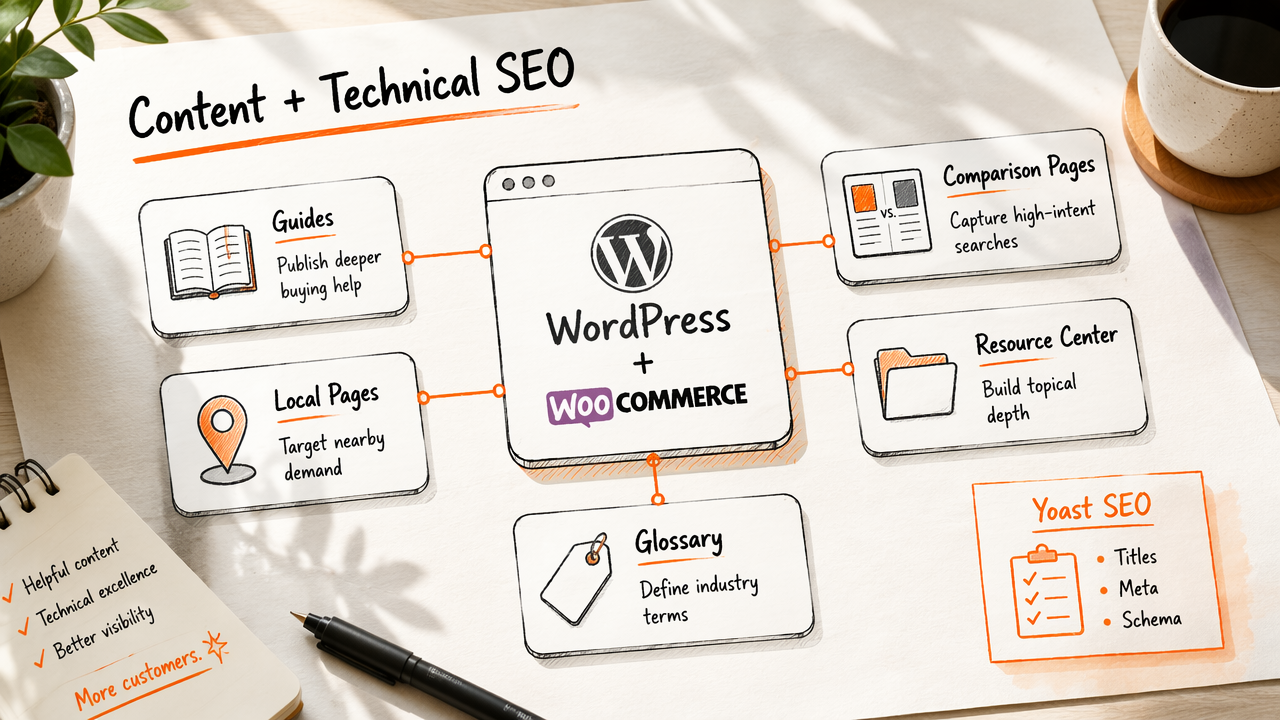
WordPress started as a publishing platform, so content modeling is its natural strength. Editorial teams can build guides, comparison pages, local pages, resource centers, glossary pages, and product education hubs with fewer structural limits than Shopify.
Yoast SEO: Yoast SEO is a search engine optimization tool plug-in for WordPress. It is one example of how WordPress extends SEO through plugins rather than only built-in platform settings.
The Earlyseo WordPress integration is relevant for teams that want to keep WordPress as the publishing base while adding a more repeatable content workflow. That can help when product education, category support, and long-tail search pages need steady output.
WordPress tradeoffs that teams must plan for
WordPress control comes with ownership. Hosting quality, caching, plugin conflicts, theme code, database bloat, security updates, and WooCommerce performance can all affect SEO outcomes. A well-built WordPress store can be very fast and flexible. A neglected one can become fragile.
Common cost categories include:
- Hosting and content delivery setup.
- Premium theme or custom design work.
- WooCommerce extensions for ecommerce features.
- SEO, schema, caching, forms, and security plugins.
- Developer time for updates, fixes, and custom templates.
That flexibility pays off when a brand needs custom category logic, programmatic landing pages, content hubs, multilingual SEO, or advanced structured data. It is less attractive when the main need is a clean online store with a few dozen products.
How should ecommerce teams choose in 2026?
Ecommerce teams should choose Shopify for managed simplicity and WordPress for strategic control, then validate the decision against catalog size, content strategy, team skills, migration risk, support needs, and AI search visibility. In 2026, the better platform is the one a team can maintain consistently.
Decision checklist for platform fit
Use this practical filter before a migration, redesign, or new store build:
- Catalog size: Shopify fits simple and mid-sized catalogs; WordPress fits unusual content-product relationships.
- Content intensity: WordPress fits brands publishing many guides, comparisons, and educational pages.
- Technical staffing: Shopify needs less ongoing engineering; WordPress rewards stronger technical ownership.
- Support model: Shopify centralizes more support; WordPress depends on host, plugin, and developer coordination.
- Schema needs: WordPress is stronger for custom schema; Shopify works well with theme and app support.
- Migration risk: Both need redirect mapping, canonical review, metadata checks, and analytics validation.
- AI discovery: Content needs clean structure, clear answers, and machine-readable context regardless of CMS.
For content planning beyond platform choice, the Earlyseo blog resources can support topic strategy, publishing cadence, and practical SEO workflows.
How Earlyseo handles this decision
Earlyseo does not require a brand to treat CMS choice as the whole SEO strategy. The stronger approach is to separate platform infrastructure from content operations: Shopify or WordPress can run the store, while a repeatable SEO workflow handles briefs, publishing, internal linking, and updates.
In AI-assisted search, clear source files and crawlable context are becoming more valuable. Teams building answer-engine visibility can review the llms.txt guidance from Earlyseo to understand how structured signals may support discovery by large language models. More implementation details are available in the Earlyseo documentation. Visit earlyseo.com when a team needs a practical way to connect platform SEO with ongoing content production.
FAQ about Shopify and WordPress SEO
Is Shopify or WordPress better for SEO in 2026?
Shopify is better for ecommerce teams that want a managed platform, fast setup, and fewer technical responsibilities. WordPress is better for teams that need stronger publishing tools, custom site architecture, and more technical SEO control. Both can rank well when pages match search intent, load quickly, use clean internal links, and avoid thin content.
Does Shopify have worse SEO because URLs are less flexible?
Shopify's fixed URL patterns can limit advanced architecture, but that does not automatically make Shopify SEO worse. Many stores rank with Shopify because product relevance, collection quality, internal linking, page speed, and backlinks still matter. URL flexibility becomes a bigger issue for brands with complex catalogs or unusual taxonomy needs.
Is WordPress with WooCommerce too hard for a small store?
WordPress with WooCommerce can be too much for a small store if no one owns updates, hosting, plugin conflicts, backups, and security. It can be a strong choice when the business also needs a rich content program or custom landing pages. The decision depends less on size alone and more on operational skill.
Should a store migrate from Shopify to WordPress for better rankings?
A migration should happen only when the current platform blocks a clear SEO requirement, such as advanced content architecture, custom schema, or complex taxonomy. Moving platforms does not guarantee higher rankings. A safe migration needs URL mapping, redirect testing, metadata preservation, analytics checks, sitemap review, and post-launch crawl monitoring.
Conclusion
The practical answer to shopify vs wordpress seo is simple: Shopify is the safer default for small ecommerce teams, while WordPress is the stronger choice for content-heavy brands with technical support. Before choosing, map the catalog, content plan, support model, and migration risk. Then pick the platform that can be maintained every month, not just launched once. For teams ready to connect SEO planning with publishing execution, Earlyseo and earlyseo.com offer a focused next step.